Introduction
Lighthouse – A structure from which light is projected at night, or which serves as a marker by day, to guide ships sailing in coastal waters. Lighthouses are constructed at important points on a coastline, at entrances to harbors and estuaries, on rocky ledges or reefs, on islands, and even in the water. Lighthouses help identify a ship’s location, warn ships of potential hazards, and notify them that land is near. Lighthouses differ from smaller beacons in that a lighthouse includes living quarters for a lighthouse keeper. Today, however, most lighthouses use automatic lights that do not require a full-time resident operator.
History

One of the first known lighthouses was also the greatest and most famous of all lighthouses. It was built in 285 BC at Alexandria, Egypt, on an island at the entrance to the city’s harbor. This lighthouse, called the Pharos of Alexandria, was one of the Seven Wonders of the World. It was over 440 ft tall and stood for 1500 years, until it was destroyed by an earthquake. The Romans constructed lighthouses in several harbors, as far away from Rome as Dover in Britain. One of Italy’s most famous lighthouses was built in 1161. Located at Genoa, this lighthouse was manned in 1449 by Antonio Columbus, uncle of famous explorer Christopher Columbus.
Extensive lighthouse construction did not occur in modern times until the 17th century. Prior to that time, most lighthouses were harbor lights serving as homing beacons so boats could safely find their way into port. Beginning in the 17th century, however, as travel on the high seas increased, major coastal lighthouses were constructed to warn mariners of dangerous rocks, reefs, and currents. Twelve lighthouses were constructed in Britain’s American colonies in the 18th century. The first was built in 1716 in Boston Harbor.

By 1900 nearly 1,000 lighthouses, both coastal and harbor types, had been built in the United States. Although estimates vary, as many as 50,000 lighthouses may exist in the world today. At the end of the 20th century most of these lighthouses were either automated or abandoned. Before the use of electric beacons, the lighthouse keeper had to keep the gas beacon lit, clean the reflecting mirrors, and remove soot from the tower windows.
With the introduction of automated electric beacons, the lighthouse keeper became all but obsolete. In addition, modern satellite-based navigational systems that can be installed on ships of all sizes have replaced the lighthouse as a primary navigational aid.
Today, lighthouses that have been automated are used primarily as backups for marine navigation, while many other lighthouses are no longer in operation. Some national governments have turned control of these abandoned structures over to local governments and nonprofit organizations. In many cases, abandoned lighthouse sites are being turned into parks, museums, inns, and research and educational centers.
Beacons
The first lighthouses were built long before the time of Christ. The earliest known reference to a lighthouse dates back to 1200 bc. This reference appeared in the Iliad, Homer’s Greek epic poem. The first onshore beacons that were used to guide ships were bonfires. Eventually, bonfires were replaced with iron baskets filed with burning wood or coal and suspended on long poles. It was not until the 1st century that these baskets were replaced by oil or gas lanterns. In the early to mid-20th century, electric beacons replaced oil and gas lanterns.
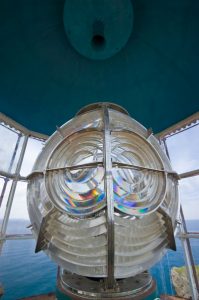 One of the most important developments in the technology of lighthouse beacons was the invention of the Fresnel lens. Developed in 1822 by French physicist Augustin Fresnel, the Fresnel lens is a collection of multiple glass prisms (transparent bodies consisting of two or more usually flat surfaces and used to bond a beam of light) that bond nearly all the available light into a powerful magnifying lens. The magnifying lens projects an intense beam of light that is visible up to 45 km (28 ml) away, A Fresnel lens used in a lighthouse beacon is an array of glass prisms and and occasionally a “bull’s eye” lens that is usually encased in a frame of solid brass. The lens, which surrounds a single lamp, consists of a central glass disk surrounded by concentric glass rings that decrease in thickness moving away from the central disk. Horizontal rows of glass prisms are located above and below these concentric glass rings.
Modern lighthouse beacons vary in power from about 10,000 candelas to about 1 million candelas, depending on the prevailing weather conditions and the visibility requirements of shipping traffic in the particular area. (The candela is the unit used to measure the amount of light that a source radiates in a given direction. One candela is equivalent to about one two-hundredth of the brightness of a 50-watt light bulb.) Every lighthouse emits a distinctive series of flashes known as its characteristic. These flash sequences allow ship captains to time intervals between flashes so that they can identify lighthouses, using a publication called the Light List. This publication assigns a number to each lighted beacon and describes its identifying characteristics. Flash sequences include the following: fixed, occulting, flashing, isophase, group flashing, alternating, and Morse code.
A fixed light is a light that shines continuously. An occulting light has longer periods of light then of darkness, while a flashing light has longer periods of darkness than of light. An isophase light has equal durations of light and darkness. A group flashing light has a specified number of regularly repeating flashes of light, while an alternating light shows light of different colors. Morse code shows short and long flashes that represent dots and dashes, respectively. These dots and dashes are grouped to represent code characters.
Foghorns & Radio Signals
Many lighthouses are equipped with a horn to help guide ships sailing in foggy weather. These foghorns, which make their sound by quickly releasing compressed air, can be heard for distances of up to 13 km (8 mi). Ship captains can determine their position by identifying distinctive combinations of long and short horn blasts specific to each lighthouse. Some lighthouses are also equipped with radio beacons that transmit Morse-code radio signals. These radio signals, which are distinguished by short (dot) and long (dash) combinations, have a range of up to 320 km (200 mi).
Lighthouse Structure & Appearance
By day, lighthouses often serve as landmarks for ship captains seeking to identity their position along a coastline. Thus, lighthouses vary in shape, size, and color. Lighthouses can be square, round, conical, rectangular, and even octagonal (eight sided). Some are painted with identifying stripes, spirals, or diamond patterns. Some have twin, and in one case triple towers. Most lighthouses range in height from 10 m (33 ft) to 63 m (208 ft).
Lighthouses are built from wood, stone, brick, reinforced concrete, iron, steel, or aluminum. They are designed to withstand local environmental conditions. For example, tall skeletal lighthouses located in the Caribbean offer less surface area to hurricane-force winds and waves. Lighthouse designs often reflect architectural styles of the time the lighthouses were built.
Lightships & Lesser Beacons
In the 19th century, lightships, which are essentially floating lighthouses, were stationed in coastal waters where lighthouses could not be built. A lightship displayed one or more lights from a mast or masts as an aid to navigation. At one time or another, more than 120 lightships dotted the coastal waters of the United States.
By 1985 all U.S. lightships had heen replacod by buoys that are equipped with an automated beacon and fog signal. These massive buoys, called Large Navigational Buoys, measure 12 m (40 ft) in diameter and are among the largest of a variety of navigational aids known as lesser beacons. Lesser beacons include river lights, fog signals, and numerous other smaller navigational aids used to mark channels in rivers and harbors. Today hundreds of thousands of lesser beacons are in use throughout the world.
Further Reading:
President James Hyland discusses the founding and mission of The Lighthouse Preservation Society.
